• Exhibitions
    • Hong Kong
    • Dubai
    • Seoul
    • Tokyo
    • London
    • New York
    • Venice
    • Tbilisi
    • Bangkok
  • Network
  • Practice
Art Curatorial Nomads
  • FINDART ↗
  • WORKFLOW.ART
  • Contact

SEOUL / 2025

Handful of Dust

Studiya Gallery

2025

ARTISTS

Juri Wi / Yasy Bachurina / Chunkook Lee / Ángela Leyva / Yutaro Inagaki / Irina Razumovskaya / Nicky Sparre-Ulrich / Goujirou

DATES

2025

LOCATION

Studiya Gallery
Seoul

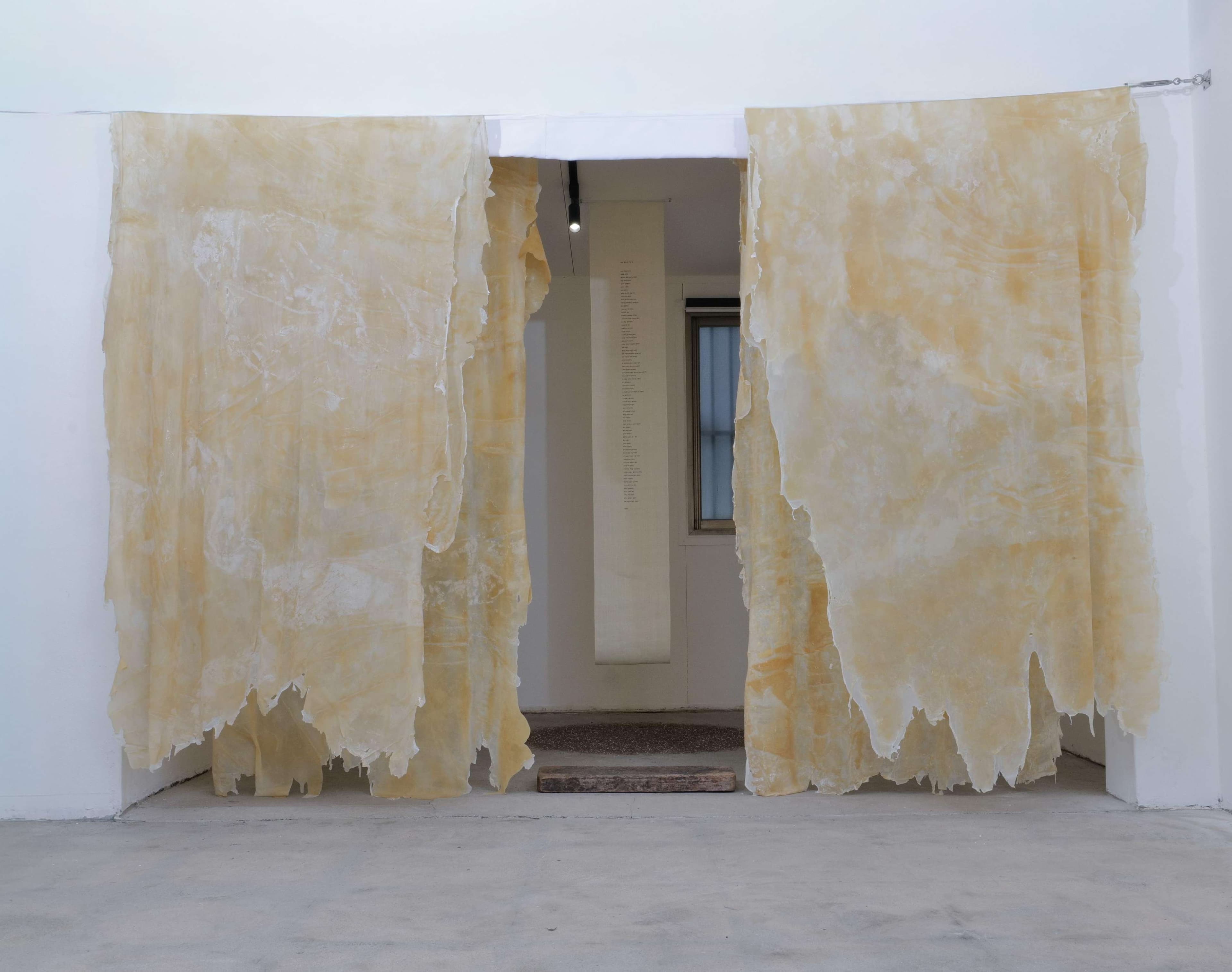
Handful of Dust is a reflection on what remains when meaning fades. The exhibition explores untranslatable fragments, obsolete gestures, and materials that continue to exist even after their function has been lost. It is not about nostalgia or archaeology, but about residues — things that have fallen out of time yet still quietly persist.

The works may appear as «mistakes» — rough, uncertain, unresolved. Yet in their detachment, they become autonomous, gaining their own life. Handful of Dust is not about loss, but about residue — not about reconstruction, but about staying close to what lies beyond time, and still speaks, even if we can no longer decipher it.

INSTALLATION VIEWS

FEATURED WORKS

About the Artists

Juri Wi

Juri Wi's practice unfolds as a search for the «lean body» — a state stripped of societal calluses and structural excess. Her work becomes an act of peeling back layers to expose what flows beneath. She imagines bodies as porous and alive, where fermentation, decomposition, and breath exist in unbroken dialogue. Through this, she invites openness, vulnerability, and renewal.

Her visual and conceptual language challenges overgrown systems of distribution, creating channels for reconnection. Each piece acts as a liberation from silence and stagnation. By grounding her practice in slowness and rooted presence, she resists the abrasion of constant friction. Her works speak of integrity, absorption, and the quiet strength to remain whole.

Informed by both touch and metaphor, her art envisions a skin just beyond searing—a surface both bright and full of air, sustaining life in its most essential form.

Ángela Leyva

Ángela Leyva's work explores the intersections of identity, memory, and technology. She merges painting with artificial intelligence, creating characters that question the boundaries between the human and the artificial.

Her portraits—often inspired by the faces of patients with congenital disorders—unsettle conventional notions of beauty. They confront viewers with the complexity and vulnerability inherent in human existence. By combining traditional painterly techniques with machine learning processes, Leyva generates a visual dialogue between the real and the virtual. This dialogue opens a space for reflection on the shifting nature of selfhood.

Her compositions operate as psychological landscapes where intimacy, distortion, and empathy coexist. Each work becomes an act of resistance to the homogenization of identity. Based in Mexico City, Leyva has exhibited widely in Mexico and abroad, with solo and group shows in major museums and international venues, earning multiple awards in contemporary painting.

Nicky Sparre-Ulrich

Nicky Sparre-Ulrich's practice is built around working with layers that reflect the passage of time and the overlap of cultural strata. He merges contemporary visual language with historical imagery, creating a charged field of meanings.

The artist explores the origins of culture, gazing into forgotten images and traces that lead deep into history. His works become an attempt to capture the beginnings of human memory and the roots of collective imagination.

Born in 1986, Nicky Sparre-Ulrich works with painting, maybe with various mediums. In 2017, he graduated from The Royal Danish Academy of Fine Arts.

Yutaro Inagaki

Inagaki creates figurative paintings that reimagine everyday life within futuristic urban landscapes. His work blends the immediacy of street culture with a refined studio practice. Figures in his paintings are often rendered in synthetic, black surfaces, masking cultural or regional markers. This anonymity evokes a post-human presence within familiar cityscapes.

His visual language reflects a deep interest in the relationship between individuals and the collective. By stripping away personal identity, he foregrounds shared emotional and spatial experiences.

Themes of repression, desire, and gentrification run through his compositions. Each canvas becomes a stage for the tensions embedded in contemporary metropolitan life. Raised near Tokyo and shaped by graffiti and urban exploration, Inagaki's practice remains rooted in the texture of the city. He is currently based in London, expanding his work to murals, public art, and gallery settings.

Chunkook Lee

Chunkook Lee integrates nature-based patterns and motifs with human anatomical structures, constructing symbolic visual imagery rooted in mythology, fantasy, and religion. Working across sculpture, installation, and objects, he employs diverse materials and everyday items to create distinctive, unconventional forms.

By merging different techniques and materialities, his practice expands painting into three dimensions, while flat sculptural elements enhance depth and texture. Through this interplay between two- and three-dimensional forms, Lee explores the shared essence of nature and life, encouraging a broader perception of their interconnectedness.

Yasy Bachurina

Yasy's practice is built on fragment and time. The artist is inspired by archaic images of material culture which, going deep into history, make it possible to speak about our common present.

She works with objects as new carriers of memory - not reproducing the past, but collecting its echoes in the present through oil painting and work with objects, using natural «primary materials» - wood, clay, stone, as well as found artifacts.

Irina Razumovskaya

Irina Razumovskaya creates hand-built ceramic sculptures that intertwine female identity, cultural memory, and the experience of diaspora. Her works reimagine decay as a site of beauty, resilience, and transformation. Rooted in material sensitivity, her forms carry historical references while asserting a contemporary voice. Each piece holds the tension between fragility and endurance.

Her practice bridges traditions of craftsmanship with conceptual narratives. Through this, she situates ceramics as both vessel and storyteller. Based in London, Razumovskaya exhibits internationally and has works in major public collections across Europe and Asia. She has received prestigious awards, including recognition from the Loewe Craft Prize and the Faenza Prize.

Goujirou

Goujirou's art emerges from the collision of critical analysis and free experimentation. His works explore the boundaries between fashion and sculpture, turning garments into statements.

Volume and form play a central role, treated not as decoration but as an independent language. Materials become tools of inquiry, whether textile, sponge, or unconventional surfaces. Mistakes and failures are integral to his method, as destruction often leads to new silhouettes. This process opens a space for intuition and unpredictable outcomes.

ART CURATORIAL NOMADS

Curatorial collective working across contemporary art, digital culture, and international exhibitions.

  • Exhibitions
  • Network
  • Practice
  • FindArt
  • Workflow
  • Contact
artcnomads@gmail.com@artcnomads

(c) 2026 ACN